

On September 3, more than 300 founders, investors, business leaders, and community supporters gathered in Elk Grove for the fifth annual Pitch Elk Grove startup competition.
The numbers alone tell part of the story. A record 109 startups applied this year, ten made it to the final stage, and $20,000 in prize money was awarded.
But for those of us working with medical, life science, biotech, and healthcare startups, there was another takeaway: science-driven companies are becoming an increasingly visible part of the Greater Sacramento startup ecosystem.
Two of this year’s three top finishers are building companies based on biological science.
Krokos Bio Takes First Place

1st Place Winner: Krokos Bio
Davis-based Krokos Bio won the $10,000 first-place prize.
The company is developing a plant cell culture platform to produce high-value botanical ingredients without relying on traditional agriculture. Its first target is saffron, one of the world’s most expensive agricultural products.
Instead of growing acres of saffron crocus, Krokos Bio grows plant cells in controlled bioreactors. The company believes this approach can reduce dependence on climate, land, water, labor, and unpredictable agricultural supply chains while producing botanical ingredients at scale.
For life science entrepreneurs, the interesting part of Krokos Bio isn't simply saffron.
It is the platform.
Plant cell culture has been used commercially before, including in the production of paclitaxel, a plant-derived chemotherapy drug. Krokos Bio is taking similar biomanufacturing concepts and applying them to a broader range of botanical ingredients.
That is a lesson worth paying attention to.
Some of the strongest science-based startups don't begin by trying to solve every possible application of their technology. They find an initial market where they can demonstrate that the platform works, establish manufacturing capabilities, develop intellectual property, and build a business.
Then they expand.
Pheronym Brings Biotechnology to Agriculture
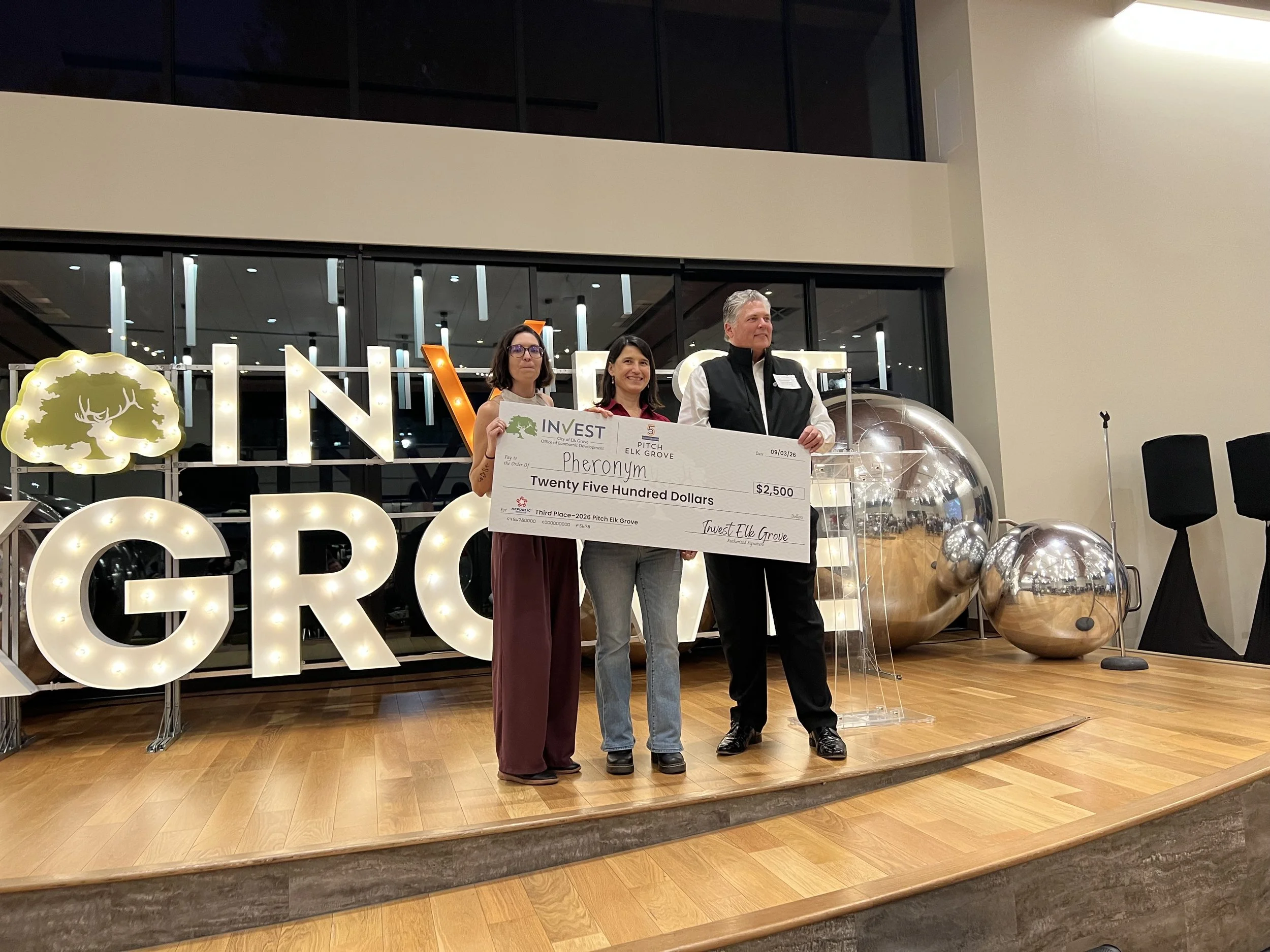
3rd Place Winner Pheronym
Third-place winner Pheronym, Inc. of Woodland received $2,500 for its work developing biological alternatives to traditional agricultural pest control.
Led by co-founder and CEO Dr. Fatma Kaplan, Pheronym uses pheromones to influence the behavior of nematodes, microscopic roundworms found in soil.
The company's technology is being developed both to improve beneficial nematodes used to kill insect pests and to control plant-parasitic nematodes that damage crops.
Pheronym is technically an agricultural biotechnology company, but the commercialization challenges will sound very familiar to medical and life science founders.
You have a scientific discovery. You have to prove that it works outside the laboratory. You need a product customers can actually use. You need manufacturing. You need intellectual property. You have to navigate regulatory questions. And eventually someone has to pay for it.
Great science is necessary.
It is not, by itself, a business model.
That transition from research to product is one of the hardest parts of building any science-based company.
Insta Brow Wins Two Awards
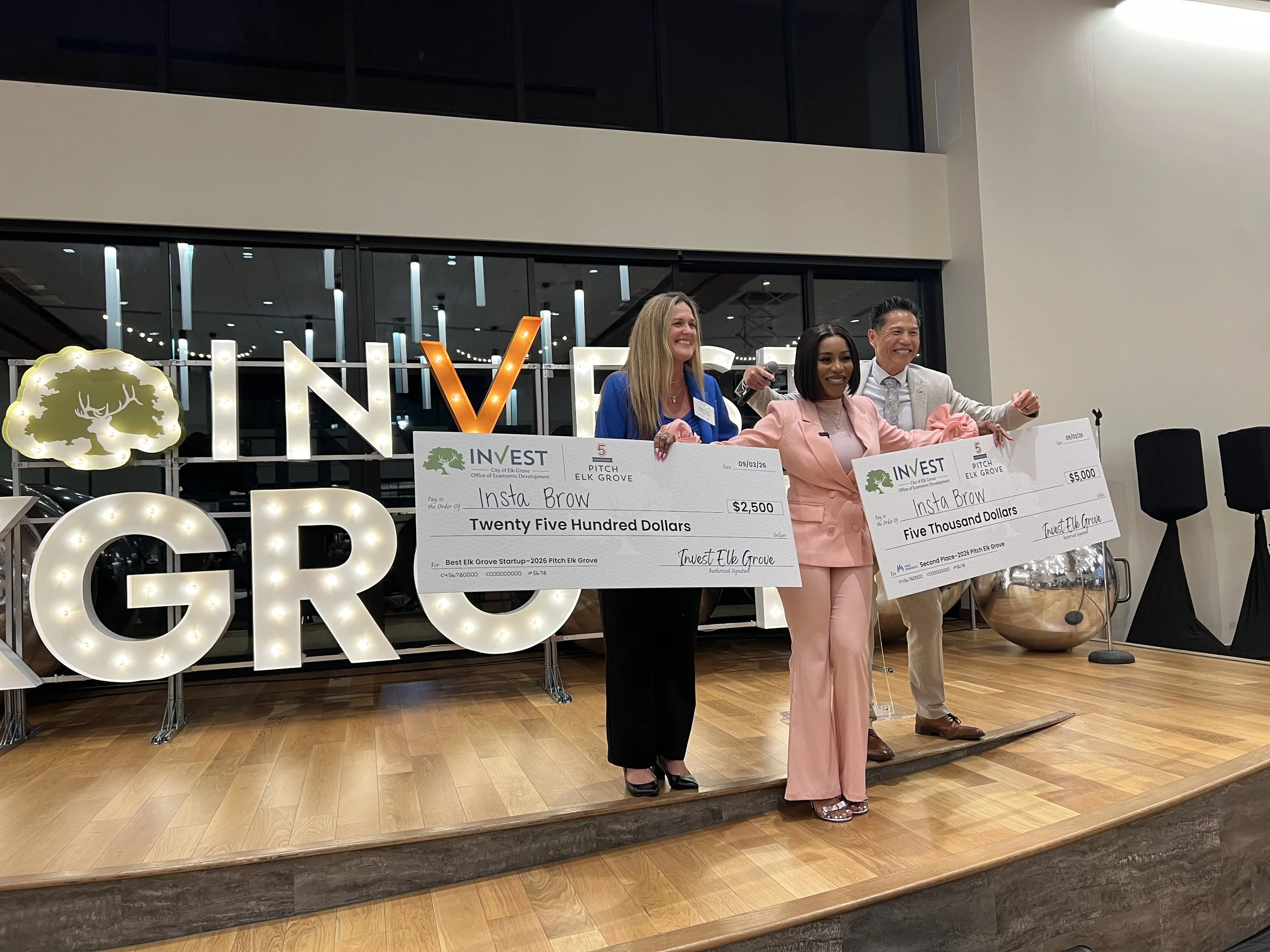
Insta Brow of Elk Grove took second place and also won the Best Elk Grove Startup Award, becoming the first company in Pitch Elk Grove history to win two prizes at the same competition. Combined, the company received $7,500.
Founder Destiny Oliphant developed a patent-pending waterproof brow stain that can be applied in approximately 30 seconds and last for up to five days.
At first glance, a beauty product may seem far removed from biotech or medical technology.
But there is a useful founder lesson here too.
Oliphant spent years working directly with customers and repeatedly saw the same problem: people with sparse, thinning, uneven, or light eyebrows were spending time filling them in every day with products that could smear or wear off. She eventually worked with a chemist to develop a different solution.
That is customer discovery in its most basic form.
Start with a problem people experience repeatedly. Understand it better than anyone else. Then develop a solution customers are willing to adopt.
Medical entrepreneurs sometimes do this backward. We start with an interesting technology and then go searching for a market.
Whenever possible, start with the clinical or customer problem.
The Bigger Story May Be What Happens After the Pitch
One of the more interesting parts of this year's event was a new "Where Are They Now?" video series looking at eight companies that previously competed at Pitch Elk Grove.
The companies included JAPA, Foodom, Redline Safety, Matrubials, EnlitenAI, ValleyMatch, IGH Naturals, and LogRx.
Several of those names should be familiar to people involved in the Sacramento medical and life science community.
The companies were at very different stages when they originally competed. Some were validating prototypes. Others were looking for their first customers, investors, or strategic partners.
Since then, the companies featured in the series have collectively experienced milestones including acquisitions, outside investment, national expansion, partnerships, and FDA progress.
That is probably the most important part of a pitch competition.
The check is nice. The trophy is nice. Getting your picture taken holding an oversized check is definitely nice.
But the real question is what happens during the next three or four years.
For a medical startup especially, commercialization is usually a marathon disguised as a pitch competition.
Clinical validation takes time. Regulatory strategy takes time. Reimbursement takes time. Manufacturing takes time. Fundraising certainly takes time.
Winning a pitch competition doesn't mean you've made it.
It means somebody thinks you've built something worth watching.
A Stronger Regional Pipeline
Pitch Elk Grove is produced by the City of Elk Grove's Office of Economic Development through Invest Elk Grove in partnership with StartupSac and other regional partners. This year's record application and attendance numbers suggest that Greater Sacramento's startup pipeline continues to mature.
For the medical and life science community, that's encouraging.
Successful biotech ecosystems aren't built around one university, one accelerator, one investor, or one city. They develop when researchers, clinicians, founders, investors, manufacturers, economic-development organizations, universities, and experienced entrepreneurs repeatedly cross paths.
Sometimes those connections happen at a laboratory bench.
Sometimes they happen at a clinical conference.
And sometimes they happen because ten founders walked onto a stage in Elk Grove and had a few minutes to convince a room full of people that their idea deserved a chance.
Congratulations to Krokos Bio, Insta Brow, Pheronym, and all of the Pitch Elk Grove 2026 finalists.
The competition may be over.
For these companies, the interesting part is what happens next.
