
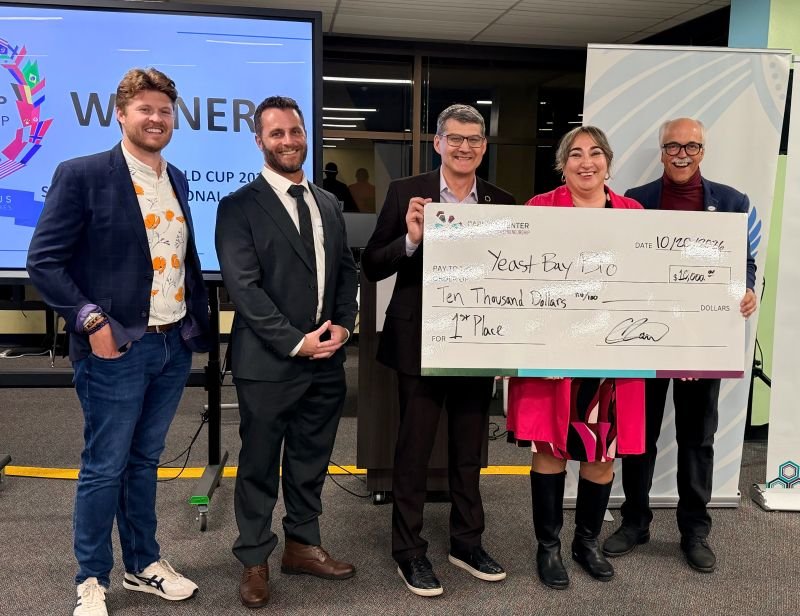
Yeast Bay Bio, led by co-founder Nazzy Pakpour, took top honors at the competition held at the Carlsen Center for Innovation & Entrepreneurship at Sacramento State.
The company received $10,000 in non-dilutive funding and $10,000 in legal services. More importantly, it earned the opportunity to represent the Sacramento region at the Startup World Cup Grand Finale in San Francisco, November 4–6, 2026, where startups will compete for a $1 million investment prize.
For Sacramento's growing life science and biotechnology community, the win highlights something important: innovative science coming out of our region has the potential to become commercially successful companies.
Turning Biotechnology Into a Commercial Product
Yeast Bay Bio is developing an innovative approach to pest control using biotechnology.
Conventional pest control products often rely on chemical pesticides that can create environmental and human exposure concerns. Yeast Bay Bio is exploring a more targeted approach using yeast to produce RNA molecules designed to affect specific insect pests.
The company's initial focus is cockroaches, but its underlying technology could potentially be applied to other pests.
This approach is an example of RNA interference (RNAi), a biological process that can reduce the expression of specific genes.
Rather than relying on traditional chemical pesticides, RNAi-based pest control aims to interfere with biological functions essential to the target pest.
For life science entrepreneurs, the interesting part isn't just the technology. It's the opportunity to take advances in molecular biology and apply them to a large commercial problem.
The company is working at the intersection of synthetic biology, molecular biology, and industrial biotechnology.
From Scientific Research to a Startup
One of the biggest challenges for scientists interested in entrepreneurship is figuring out how to turn a promising technology into a viable business.
Developing a new biological technology is only part of the process. Founders must also identify customers, validate market demand, protect their intellectual property, develop manufacturing processes, and raise enough capital to reach commercialization.
Yeast Bay Bio illustrates how scientific expertise can serve as the foundation for a startup.
Co-founder Nazzy Pakpour brings a background in entomology, microbiology, and biotechnology to the company.
Advances in molecular biology can create commercial opportunities in agriculture, environmental protection, food production, industrial manufacturing, and many other industries.
The key is identifying a problem that customers are willing to pay to solve.
Winning $20,000 in Funding and Services
Yeast Bay Bio's victory came with three significant benefits:
$10,000 in non-dilutive funding from the Carlsen Center for Innovation & Entrepreneurship. Unlike an equity investment, non-dilutive funding allows founders to obtain capital without giving up ownership of their company.
$10,000 in general counsel services from Witan Law Group LLP. Legal assistance can be particularly valuable for biotechnology startups dealing with intellectual property, contracts, and early business formation.
A place in the Startup World Cup Grand Finale. The opportunity to compete in San Francisco provides exposure to a much larger network of investors, industry leaders, and potential strategic partners.
For biotechnology startups, even relatively small amounts of non-dilutive funding can help support important development milestones.
And while the financial awards are valuable, the opportunity to build relationships with investors and potential partners may
